
Imagine a learner reaching the end of your course. They watched the videos, downloaded the workbook and passed the quiz. Then they sit down to use what you taught, and the question arrives: “Where do I start?”
That question interests me more than a full progress bar.
My background is in mathematics. Perhaps that is why I keep coming back to the difference between following a worked example and solving a new problem. Everything can look quite straightforward while someone else is holding the pen.
The difficult moment comes when the pen changes hands.
For educators, that might be a student facing an unfamiliar question. For a coach, it might be a client trying to use a framework during a difficult conversation. Both need a course that prepares them for that moment.
This is where instructional design can help. It connects your expertise with the explanations, practice and feedback learners need to use it. At Hinova, it also gives the workbooks, presentations and online lessons a shared purpose.
If you are planning a course, improving an existing programme or wondering what an instructional designer would actually do for you, let’s make the work a little less mysterious.
What an instructional designer actually does
An instructional designer plans how people will learn something and how they will show that they have learned it. That includes understanding the audience, defining useful learning outcomes, sequencing content and designing practice and assessment.
The starting point is a question about the learner. What are they trying to do, and what is making it difficult?
Sometimes they need an explanation. Sometimes they need a model they can follow, feedback on an attempt or a resource they can use later. A designer investigates that need before deciding what to build.
This work overlaps with good teaching and lesson planning. Teachers already make many of these decisions. An instructional designer brings focused time and a structured process to the work, particularly when a course spans several units, delivery formats or contributors.
Your expertise remains central. The designer needs your judgment about the subject, the audience and what good performance looks like. The course grows through that collaboration.
Begin with something learners can do
“Understand fractions” is a reasonable ambition. It leaves quite a lot undecided.
Would success mean naming the numerator? Comparing two quantities? Explaining why one fraction is larger? Each would call for different teaching and different evidence.
For a particular lesson, a more useful outcome might be: “Compare two fractions using a diagram of the same whole, and explain which represents the larger amount.”
Now the design decisions have somewhere to go. Learners need to see a clear model, try comparisons with support and eventually explain an unfamiliar example themselves.
Educators call the connection between the outcome, the teaching and the assessment alignment. Carnegie Mellon University’s Eberly Center explains why all three need to reinforce one another.
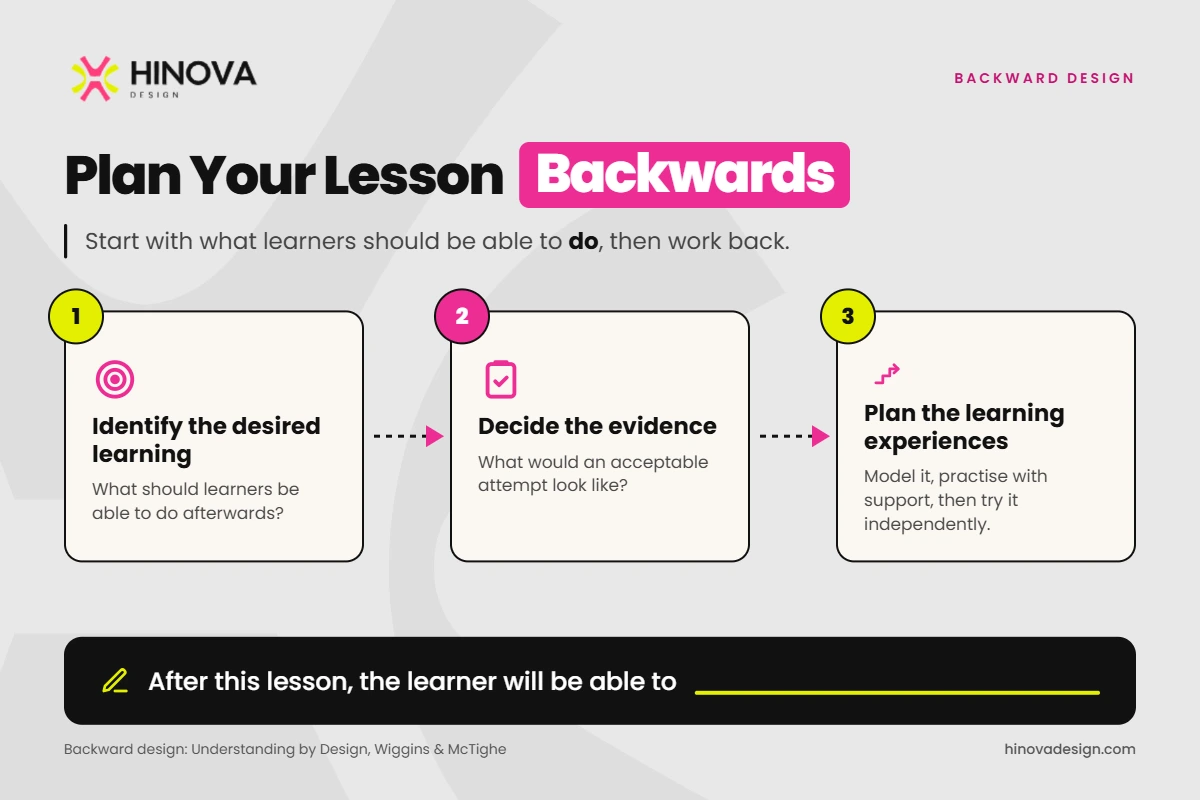
One way to plan that connection is backward design, used in Understanding by Design by Grant Wiggins and Jay McTighe. Identify the desired learning, decide what evidence would demonstrate it, then plan the learning experiences.
For your own course, begin with this sentence:
After this lesson, the learner will be able to ________.
Then describe what an acceptable attempt would look like. “Write a proposal” becomes more useful when you specify that it must respond to the client’s brief and include an appropriate scope and next step.
You are giving yourself a way to make decisions about every page and activity that follows.
How instructional design helps educators
Consider a hypothetical fractions unit in a private academy. The syllabus is ready, the teacher has a presentation and the worksheet contains plenty of questions. Students do well when the questions resemble the examples. Change the format, and some become unsure.
Before adding another worksheet, I would want to understand that uncertainty. Are students following a procedure without understanding the quantities? Are the diagrams confusing? Have they had enough opportunities to explain their reasoning?
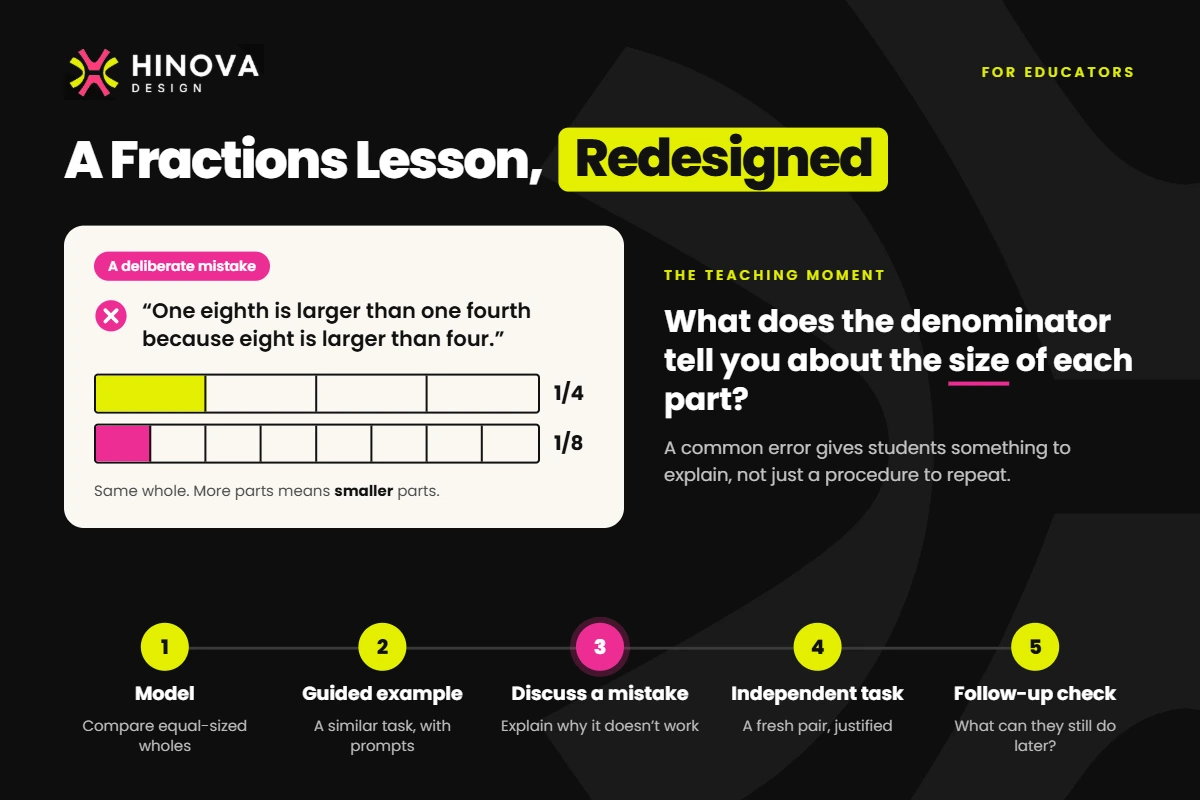
A revised sequence could begin with a teacher modelling a comparison using equal-sized wholes. Students then work through a similar example with prompts and discuss a deliberately incorrect answer: “One eighth is larger than one fourth because eight is larger than four.”
That small mistake gives the teacher something useful to explore. Students need to explain what the denominator tells them about the size of each part.
Later, they compare a fresh pair of fractions independently and justify their answer. A short follow-up in a later lesson checks what they can still do.
The resources would support that sequence: clear diagrams, guided questions, an independent task and a simple scoring guide. The teacher can see whether the difficulty lies in the comparison, the representation or the explanation.
For a school or academic team, instructional design can also produce a shared unit plan and facilitator guidance. Teachers have a common starting point while retaining room to respond to their students.
This is useful when presentations, worksheets and assessments have developed separately. Bringing them together can reveal a missing explanation or an assessment that asks for a skill students have barely practised.
How instructional design helps course creators
A course creator faces a related challenge: much of their expertise may live inside conversations.
During a live session, you notice a confused expression and offer another example. You ask a follow-up question. You adjust. When you turn that session into a recording, those helpful interventions need to be planned.
Imagine a coach developing a course about setting professional boundaries. A module called “Be more confident” could contain a thoughtful explanation and still leave a learner unsure what to say on Monday morning.
A more workable lesson outcome would be: “Draft a response to an unreasonable request that states a limit and offers an appropriate next step.”
The lesson could show two responses to the same request and explain the choices behind each. Learners then complete a partly written response, draft their own and use a checklist to revise it. A role-play or audio response could provide further practice where the delivery format allows.
The workbook now has a specific job. It helps the learner prepare words they can actually use.
An instructional designer can help you draw those teaching decisions out of your existing material. What do beginners usually misunderstand? Which steps do you perform so automatically that you forget to explain them? What would you ask a client before giving advice?
Those questions help preserve what makes your approach useful as you develop a course that people can follow more independently.
Instructional design services and what you receive
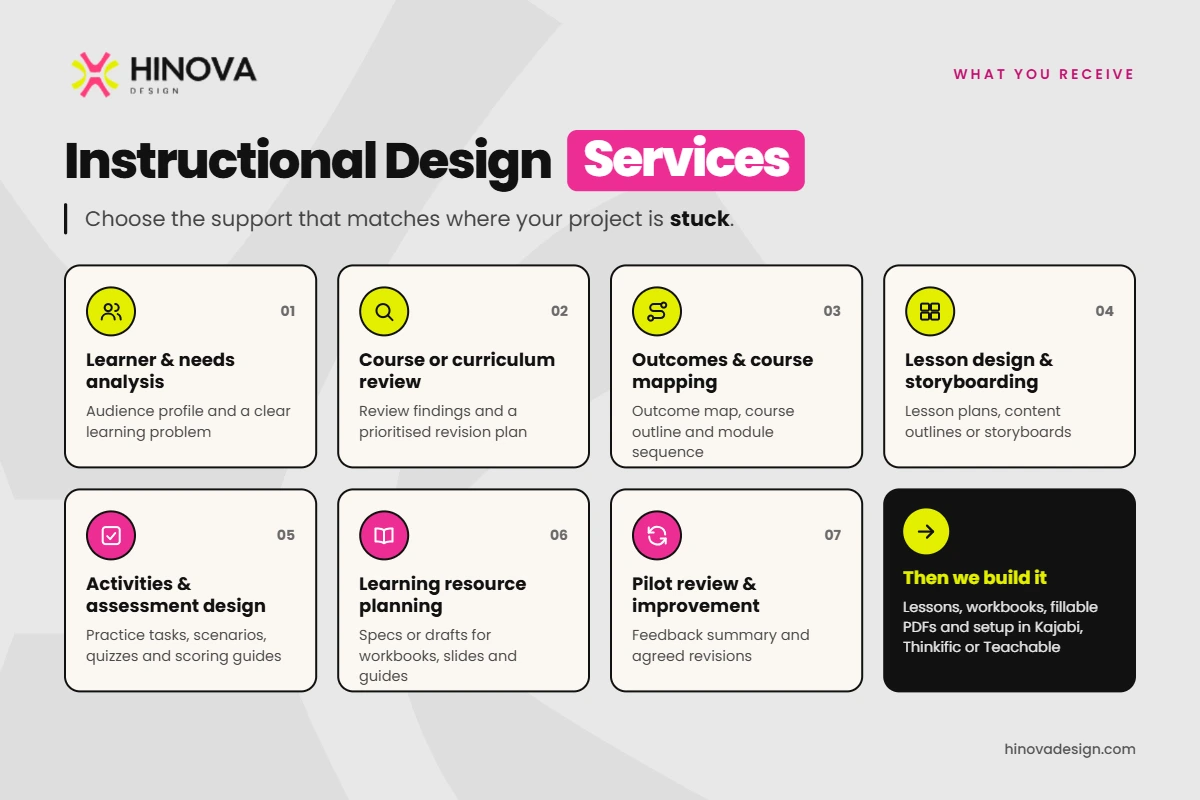
The service you need depends on where your project is getting stuck. Here is a practical guide to the work a designer may provide.
| Service | Typical deliverable | What it helps you decide |
|---|---|---|
| Learner and needs analysis | Audience profile and a clear learning problem | Who needs support and whether a course is the right response |
| Course or curriculum review | Review findings and a prioritised revision plan | Which gaps and inconsistencies need attention first |
| Learning outcomes and course mapping | Outcome map, course outline and module sequence | What belongs in the course and in what order |
| Lesson design and storyboarding | Lesson plans, content outlines or storyboards | How explanations, examples and learner actions fit together |
| Activities and assessment design | Practice tasks, scenarios, quizzes and scoring guides | How learners will practise and demonstrate the intended skills |
| Learning resource planning | Specifications or drafts for workbooks, slides and guides | Which resources learners and facilitators need |
| Pilot review and improvement planning | Feedback summary and agreed revisions | What to change after people try the learning experience |
The scope should make clear which deliverables your designer will produce and which need another specialist. Developing complex software, producing video and building an online course can involve additional work.
At Hinova, instructional design and course planning connect with our course development, document design and platform setup services. We can help turn the agreed plan into lessons, presentations, workbooks, facilitator guides and interactive fillable PDFs. Where included in the project, we can organise the course in Kajabi, Thinkific or Teachable.
That connection matters to me as a designer. A workbook page needs enough space for the response it asks for. Instructions should tell the learner what to do next. A download should be easy to find. Nobody enrolled to practise detective work.
What to plan for in 2027
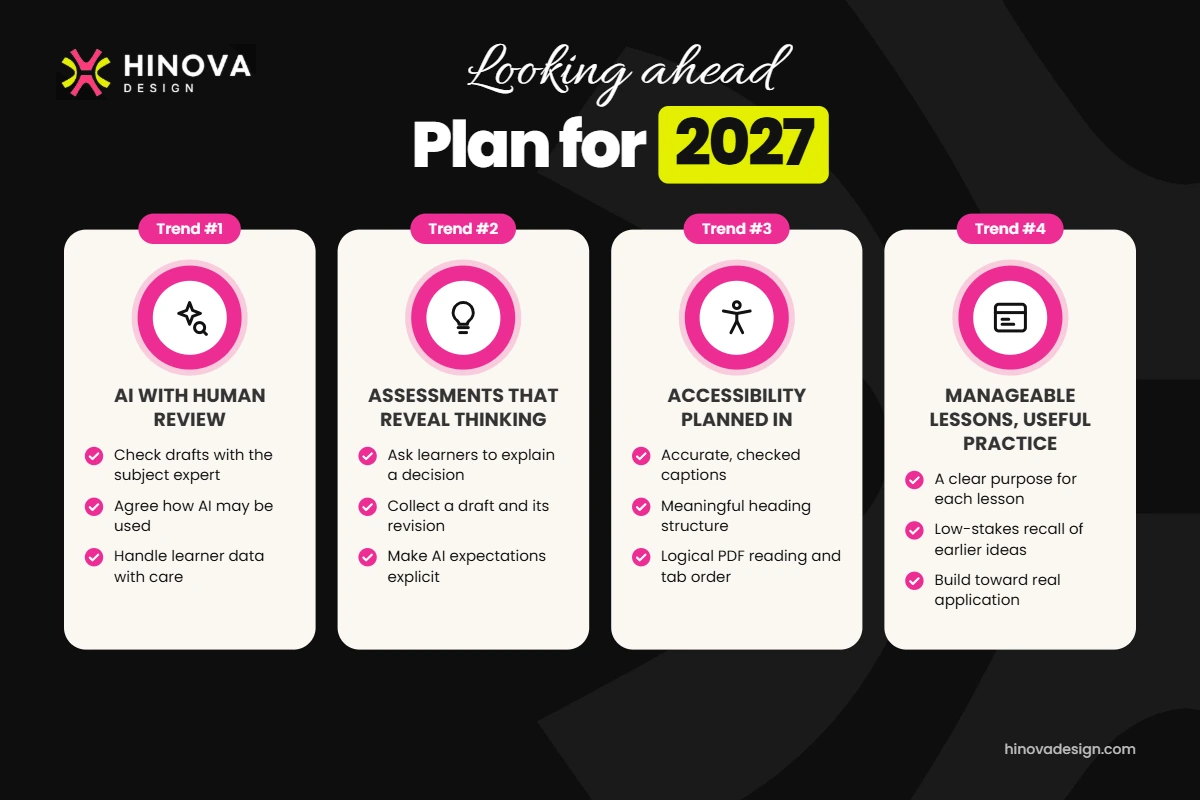
The foundations of learning design remain useful. As you plan a course launch or refresh for 2027, I would give particular attention to the following areas. The recommendations below draw on established learning research and developments reported through 2026.
AI assistance with human review
AI tools can help draft an outline, suggest examples or generate alternatives to an assessment question. I would treat those outputs as material to examine with the subject expert.
Does the example make sense? Is the answer accurate? Does the activity ask learners to do what the objective promises? A polished paragraph cannot answer those questions on its own.
UNESCO’s guidance on generative AI in education places human agency, inclusion and appropriate validation at the centre of its recommendations. For a course project, that means agreeing how AI may be used and keeping expert review in the process. Learner information also needs to be handled according to the organisation’s privacy requirements.
Assessments that reveal thinking
The 2026 EDUCAUSE Horizon Report identifies AI as a force reshaping higher education and highlights movement toward authentic demonstrations of learning and evidence of the learner’s process. This is a higher education report; its findings provide useful questions for other course settings too.
For example, you could ask learners to explain a decision, submit a draft and revision, or discuss how they approached a task. Choose a method that fits the skill you need to assess and the support available.
Make expectations about AI use explicit. If using AI is part of the intended skill, learners may need to explain how they checked and improved its output. If a task requires independent work, explain that requirement and design the assessment accordingly.
No single task format proves authorship. A well-chosen combination of evidence can give you a clearer picture of understanding.
Accessibility planned into the materials
Think about a learner who uses captions, another navigating by keyboard and someone reading your workbook with assistive technology. Their access needs belong in the design brief.
CAST’s Universal Design for Learning Guidelines 3.0 encourage options for engagement, representation, and action and expression. In practice, this can mean explaining unfamiliar vocabulary, providing an alternative representation of an idea or offering appropriate ways to respond while keeping the learning goal clear.
Technical details matter too. W3C guidance explains the importance of accurate captions, meaningful heading structure and logical PDF reading and tab order. Automatically generated captions need checking. A fillable PDF also needs its structure and navigation checked; typing into a field is only one part of using it.
For your project, agree the accessibility requirements and how the finished materials will be tested before production begins.
Manageable lessons with useful practice
I would choose a lesson’s length by looking at the task. A quick reminder might fit on one page. Explaining a difficult idea and giving learners time to apply it may take longer.
Short lessons are useful when each has a clear purpose. They also need connections, so learners can bring the smaller parts together.
Learners may also need different starting points. A brief entry check and an optional refresher can support someone who needs the basics while allowing a more experienced learner to move ahead. Choose these options around actual needs and the tools available to deliver them.
Plan opportunities to recall earlier ideas. In Roediger and Karpicke’s 2006 experiments with prose passages, students who practised recalling material performed better on delayed retention tests than students who repeatedly studied it.
For your course, a practical starting point is a low-stakes question about an earlier lesson, followed by an explanation learners can use to check their answer. Build toward application as well. Remembering a framework and using it in a difficult situation call for different kinds of practice.
How a project with Hinova can work
You can bring an outline, an existing course or a folder of material you have collected over time. We begin by understanding what you want learners to achieve and what support you need to get there.
First, we review the starting point. Who is the course for? What do they already know? How will they access it? We look at your source material and agree the scope, deliverables and review responsibilities.
Next, we map the learning. We define the outcomes and organise the lessons, activities and assessments around them. This is a useful time to decide what belongs in the main course and what can become an optional resource.
Then we develop and review. Depending on the project, this may include lesson content, presentations, learner resources and facilitator materials. You or your subject experts review accuracy and the fit with your curriculum or framework.
Finally, we prepare the agreed delivery. We refine the files and, when platform setup is included, organise the course and check the learner experience before handover. Editable formats and update responsibilities are agreed as part of the project.
For an existing course, a focused review may be enough to identify a sensible first improvement. For a new programme, working through one representative lesson before developing every module gives everyone something concrete to review.
Give one lesson a quick review
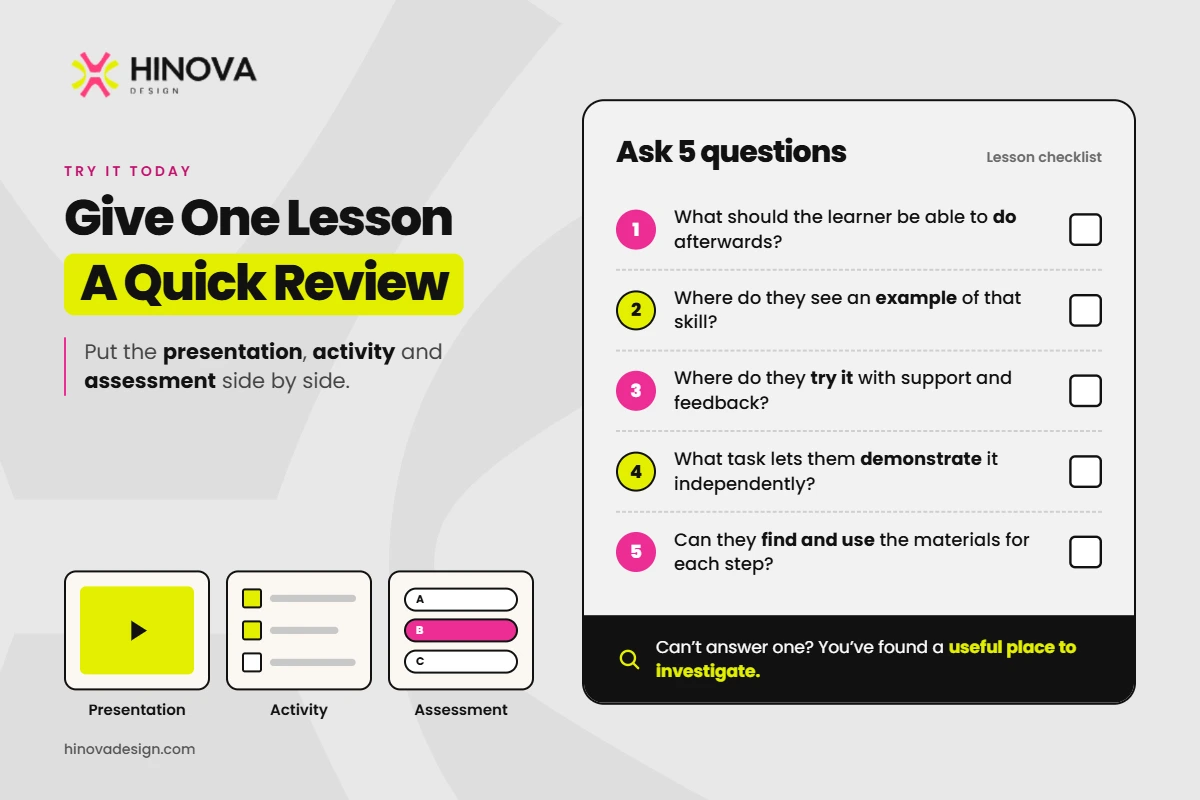
Choose a lesson that feels harder to teach than it should. Put the presentation, activity and assessment beside each other, and answer five questions.
- 1. What should the learner be able to do afterwards?
- 2. Where do they see an example of that skill?
- 3. Where do they try it with support and feedback?
- 4. What task lets them demonstrate it more independently?
- 5. Can they find and use the materials needed for each step?
If you cannot answer one of these, you have found a useful place to investigate. You may need a clearer example, an activity between the explanation and the assessment, or instructions that have been left inside the teacher’s head.
When you test a change, look at learner work as well as their feedback. Completion data can show where people stop. An explanation, draft or attempted solution can help show what they have learned. Neither tells the entire story on its own.
I would rather improve one lesson with a clear reason than rebuild an entire course around a guess.
Begin with the lesson you want to improve
Here is the question I would leave on your desk: “When learners close this lesson, what are they ready to try?”
If you can answer it clearly, you have a useful starting point. If the answer is uncertain, that is a worthwhile conversation to have before making another slide.
At Hinova Design, we help educators and course creators plan that next step and build the resources around it. Bring us the unit that feels disconnected, the coaching framework you want to teach or the course you have been meaning to organise.
Helpful answers
Frequently asked questions
Can we keep our existing content?
Yes. A review can identify what to retain, reorganise, clarify or add. An existing presentation or workbook may already contain much of what the course needs. The work can begin with one unit or resource.
Will an instructional designer change my teaching voice?
Your examples, language and professional judgment should inform the course. Share material that reflects how you teach, and use review stages to check that the lessons still sound like you. Your subject expertise remains essential throughout.
How much does instructional design cost?
The scope determines the fee. Reviewing a short unit is a different project from developing a full course with assessments, workbooks and platform setup. At Hinova, we consider the content you already have, the deliverables, their complexity and the review process before agreeing the price and timeline.