
You've spent years developing your coaching skills, refining your methods, and helping clients overcome challenges.
Your expertise works in one-on-one sessions. You know which questions to ask, which exercises create breakthroughs, and how to guide someone from feeling stuck to making progress.
But turning that knowledge into an online course?
That's where things get complicated.
You might have dozens of worksheets, recorded sessions, frameworks, and ideas scattered across different folders. You know there's a valuable course somewhere in all that material, but you're not sure what to include, how to organize it, or where to begin.
And between client sessions, running your business, and managing everyday responsibilities, finding the time to figure it all out feels overwhelming.
Here's the good news: You don't need to create everything from scratch. You need a clear structure that turns what you already know into a learning experience your clients can follow.
In this guide, you'll learn how to plan an online course for your coaching business, organize your existing knowledge into meaningful modules, and develop a practical course outline before recording a single lesson.
Why Turning Your Coaching Expertise Into an Online Course Feels So Difficult
When you're coaching someone one-on-one, your teaching happens naturally.
You listen to their challenges, identify what they need, adjust your approach, and guide them through the next step.
An online course works differently.
Your students may be learning independently, without you sitting beside them to explain confusing concepts or answer questions.
That means your course needs to provide the structure and guidance that you would normally offer during a coaching session.
For many coaches, this creates three major challenges:
1. You have too much knowledge and don't know what to include.
Years of coaching experience can produce hundreds of useful ideas. But trying to teach everything often results in a course that feels overwhelming rather than helpful.
2. You know how to coach, but you're unsure how to structure a course.
Being an excellent coach doesn't automatically mean knowing how to organize learning objectives, lessons, activities, and assessments.
3. You're afraid of spending time creating something people won't finish or buy.
Recording hours of videos takes effort. Before investing that time, you want confidence that your course addresses a real problem and helps learners achieve a meaningful outcome.
The solution isn't to start creating more content.
It's to design the learning journey first.
Step 1: Identify Your Ideal Learner and the Result They Want
Before planning modules, recording videos, or choosing a course platform, get clear about who you're creating the course for.
One of the biggest mistakes coaches make is trying to build a course for everyone who might benefit from their expertise.
For example, a career coach might want to help recent graduates, mid-career professionals, executives, and people returning to work.
While these audiences share some challenges, their needs, experience levels, and desired results are different.
Trying to serve everyone in one course can make the learning journey unnecessarily complicated.
Instead, define four things:
- Your ideal learner: Who is the specific person you're helping?
- Their current situation: What are they struggling with right now?
- Their desired outcome: What should they be able to accomplish by the end?
- Their constraints: What limits their time, resources, confidence, or ability to take action?
Example: A Career Coach Creating an Online Course
Imagine you're a career coach who regularly works with mid-career professionals feeling stuck in their current roles.
Rather than creating a broad course called Everything You Need to Know About Career Development, you could focus on a specific transformation.
Your learner: Mid-career professionals who want to change careers but don't know where to start.
Their problem: They feel unfulfilled at work, struggle to identify transferable skills, and fear making the wrong career decision.
Their desired outcome: A realistic 90-day career transition plan that identifies potential directions, skill gaps, low-risk experiments, and actionable next steps.
Now your course has a clear purpose.
Every lesson, exercise, and resource should help the learner move toward that outcome.
Ask yourself: If a student completes my course successfully, what specific task, decision, or result will they be able to demonstrate?
If you can answer that clearly, you've established the foundation for your course.
Step 2: Validate Your Course Idea Before Building It
Having expertise in a subject doesn't automatically mean there's demand for a course about it.
Before investing weeks in production, find out whether your target learners actively want help solving the problem you've identified.
Start with the people who already understand your work: your coaching clients and audience.
Look for patterns in the challenges they repeatedly bring to you.
Consider these questions:
- What problems come up most often during coaching sessions?
- Which questions do clients ask before deciding to work with you?
- What have potential clients already tried without success?
- Which outcomes are people willing to invest time or money to achieve?
You can also have short conversations with people who resemble your ideal learners.
Rather than asking, "Would you buy my course?" ask about their past behavior.
For example:
"What have you already tried to solve this problem?"
"What was difficult about those solutions?"
"What would make solving this problem valuable to you?"
These questions help reveal real frustrations instead of collecting polite encouragement.
Test the Idea With a Small Pilot
You don't necessarily need to create an entire course to test demand.
Consider offering a focused paid workshop, a short live training, or a small pilot program around your proposed outcome.
Observe whether people sign up, participate, complete the exercises, and find the experience useful.
A pilot can help you identify:
- Whether the topic attracts the right audience.
- Which concepts require additional explanation.
- What students struggle to apply independently.
- Which resources or activities are missing.
Positive feedback is useful, but actual enrollment and participation provide stronger evidence of demand.
The goal is to validate the problem and learning experience before committing to full production.
Step 3: Turn Your Existing Coaching Framework Into a Course Outline
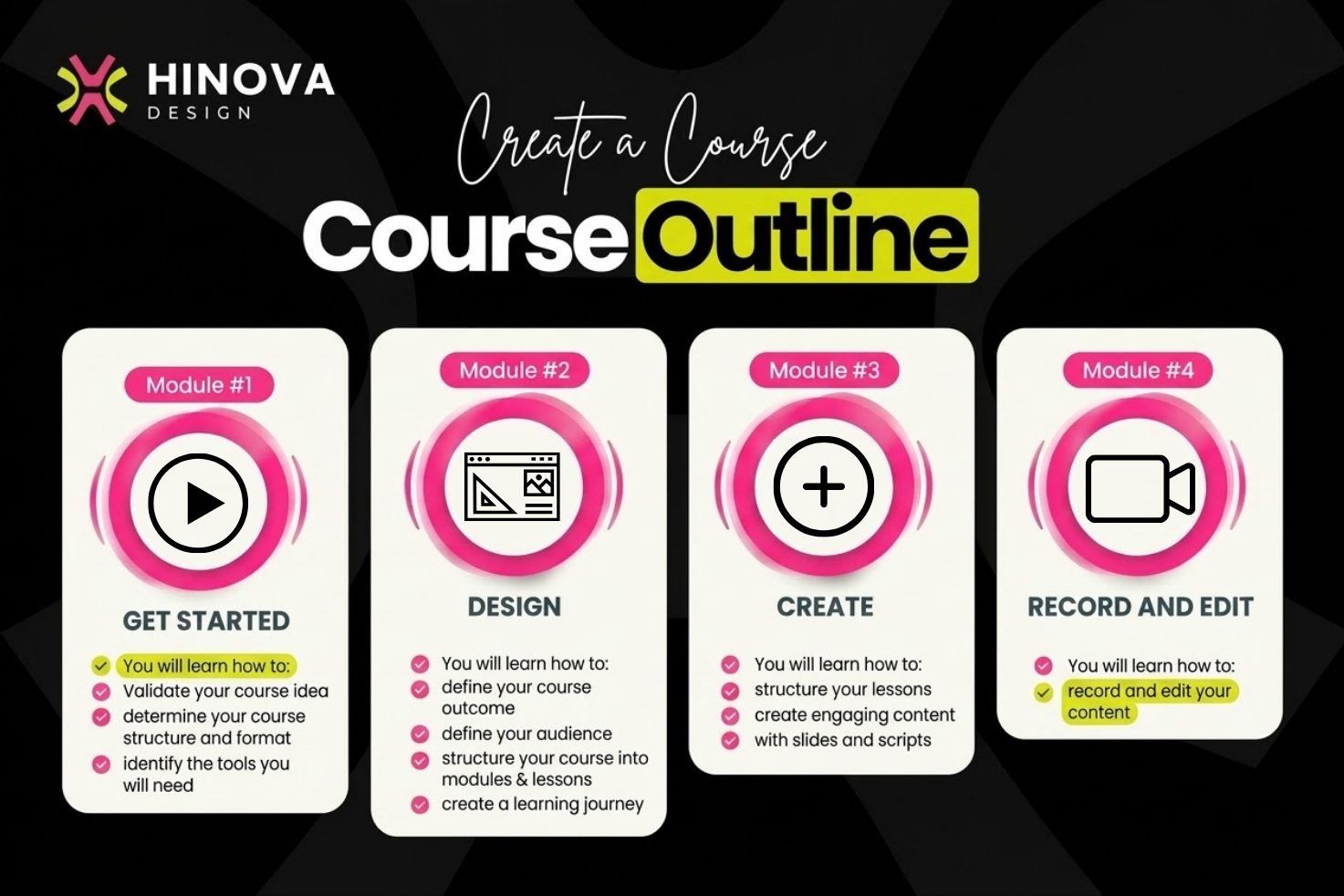
Once you understand your learner and the result they want, you can begin organizing your existing expertise.
This is where many coaches overcomplicate the process.
They assume every lesson needs to be written from scratch, even though much of their teaching material already exists in daily coaching work.
Start by collecting your existing resources.
These might include:
- Coaching session notes and recurring client questions.
- Worksheets, exercises, and reflection prompts.
- Your signature coaching frameworks or methodologies.
- Presentations, articles, and training materials.
- Recorded explanations and workshop content you have permission to reuse.
Review each resource and assign it to one of four categories.
| Category | What it means |
|---|---|
| Keep | Directly supports your course outcome and can be reused. |
| Revise | Contains useful information but needs simplifying or updating. |
| Create | A necessary lesson, exercise, or resource doesn't exist yet. |
| Remove | Interesting material that doesn't contribute to the main outcome. |
This process helps you avoid turning your online course into an information library.
Instead, you start building a focused learning experience.
Turn Coaching Sessions Into Learning Milestones
Think about the process you already follow with clients.
What happens in your first session? What comes next? Which breakthroughs must happen before a client is ready for the next stage?
For our career coaching example, the milestones might be:
- Understand why the current career path isn't working.
- Identify transferable skills, strengths, and constraints.
- Explore and evaluate alternative career directions.
- Design practical ways to test promising options.
- Create a structured 90-day transition plan.
These milestones represent the learner's progress.
Once you've identified them, you can group related milestones into modules.
The important distinction is that your course should follow the order in which learners need to develop skills, not simply the order in which you enjoy teaching topics.
Step 4: Organize Your Course Into Modules and Actionable Lessons
With the milestones identified, it's time to develop your course structure.
Think of a module as one important stage of your learner's transformation.
Each module should answer a simple question:
"What meaningful progress will the student make by completing this section?"
Using our career coaching example, a four-module course could look like this.
Module 1: Understand What's Keeping You Stuck
Learning outcome: Identify the main sources of career dissatisfaction and define personal career priorities.
Students examine their current situation, reflect on past experiences, and identify what they want to change.
Practical activity: Complete a career satisfaction assessment and create a list of nonnegotiable career priorities.
Module 2: Discover Your Transferable Skills
Learning outcome: Identify existing strengths and understand how they could apply to different career paths.
Students analyze previous roles, achievements, and professional experiences.
Practical activity: Build a transferable skills inventory supported by examples from past work.
Module 3: Explore and Test New Career Directions
Learning outcome: Evaluate realistic career alternatives and plan a low-risk experiment.
Students identify potential paths, compare them against personal constraints, and choose an option to investigate further.
Practical activity: Design one career experiment, such as an informational interview, portfolio project, or short practical assignment.
Module 4: Build Your 90-Day Career Transition Plan
Learning outcome: Create a realistic, personalized plan for moving toward a new career direction.
Students combine everything they've learned into a structured roadmap.
Practical activity: Develop a 90-day plan covering priorities, skill gaps, milestones, experiments, and decision criteria.
Notice how each module moves the learner closer to the final result.
The course doesn't just provide information about career transitions. It guides students through creating a plan they can actually use.
How to Plan Individual Lessons
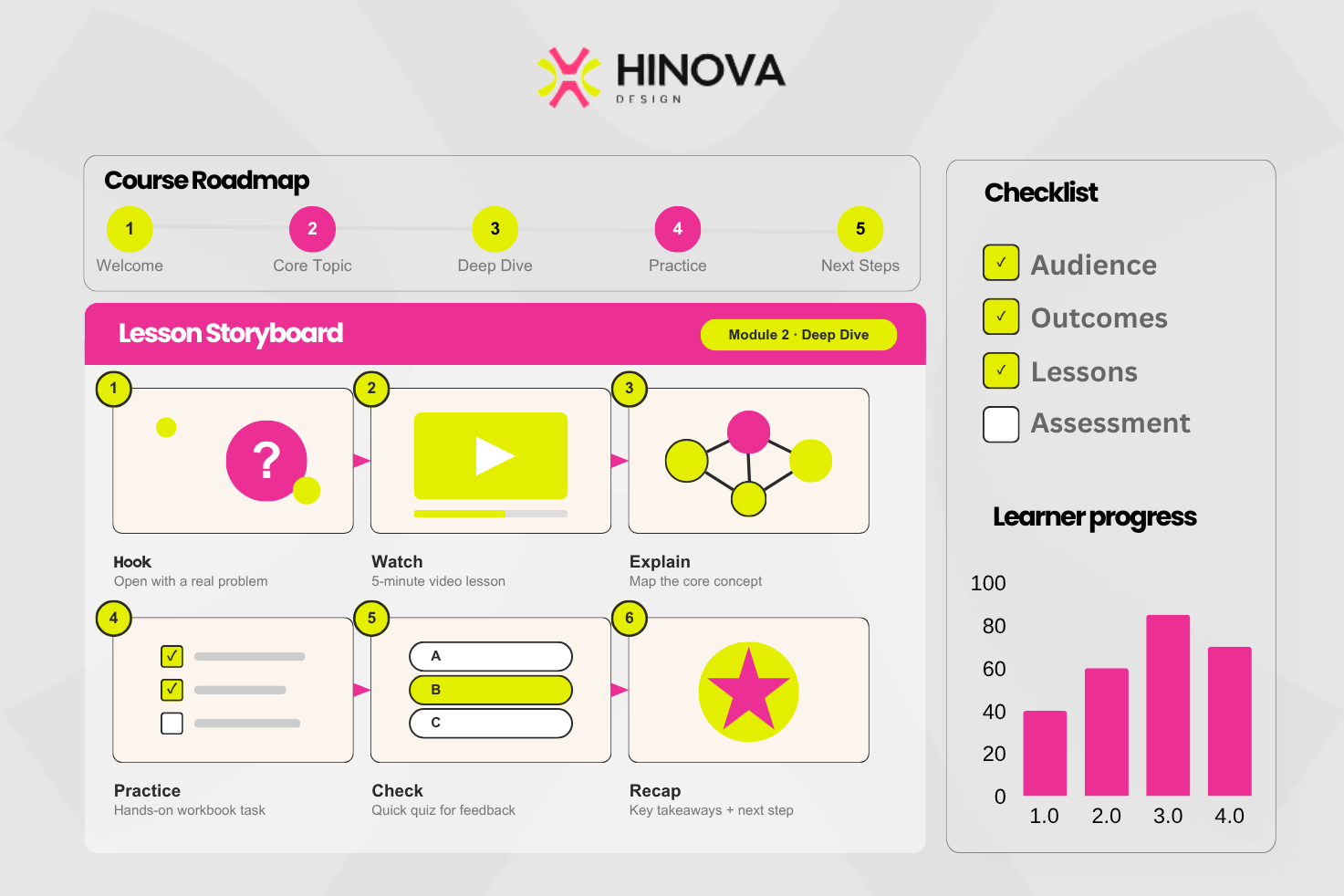
Once your modules are clear, break them into smaller lessons.
For every lesson, identify four elements:
1. Learning outcome: What will the student be able to do afterward?
2. Explanation: What knowledge or concept do they need?
3. Activity: What will they practice, create, or complete?
4. Completion check: How will they demonstrate that they understood and applied the lesson?
Here's an example of a simple coaching course lesson map.
| Lesson | Learning outcome | Activity | Completion check |
|---|---|---|---|
| Identify career priorities | Define the conditions needed for a satisfying role | Career priorities worksheet | Five ranked priorities with explanations |
| Inventory transferable skills | Recognize strengths that apply across industries | Skills inventory | Eight relevant skills supported by examples |
| Evaluate career options | Compare possible directions against personal needs | Career comparison matrix | Two shortlisted options with clear reasoning |
| Design a low-risk experiment | Create a practical way to test one direction | Experiment planner | A scheduled experiment with success criteria |
| Build a 90-day plan | Translate insights into achievable next steps | Career roadmap template | A complete plan with milestones and review dates |
This approach transforms lessons from passive content into opportunities for progress.
And it makes it easier to determine which worksheets, videos, exercises, and resources you actually need to produce.
Step 5: Choose the Right Learning Format Without Overcomplicating Production
Not every part of your coaching process needs to become a recorded video.
Some concepts are best explained through short lessons. Others require reflection, practice, feedback, or discussion.
Before choosing your course platform, consider how students will learn and apply your material.
For example:
Recorded lessons work well for explaining core concepts, demonstrating frameworks, and introducing exercises.
Worksheets and templates help students organize thoughts, make decisions, and apply what they've learned.
Interactive activities encourage practice instead of passive watching.
Live group sessions can provide feedback, accountability, and support for more complex challenges.
Self-assessments and progress checks help learners recognize gaps and evaluate their understanding.
The right combination depends on your audience, learning outcomes, and the support you want to provide.
For example, a career transition course might combine short recorded explanations with downloadable worksheets and optional group coaching sessions.
That gives students a structured learning path while preserving opportunities for personalized support.
What Should You Create First?
Prioritize the resources needed to deliver the core learning outcome.
You don't need elaborate graphics, lengthy videos, or a complicated learning platform to create your initial course.
Start with:
- A clear curriculum and module outline.
- Specific learning objectives for each lesson.
- Essential activities and worksheets.
- A lesson storyboard or delivery plan.
- A simple way to assess learner progress.
Once those pieces are clear, production decisions become much easier.
Step 6: Test Your Course Outline Before Recording Everything
One of the most expensive course-creation mistakes is discovering structural problems after production is complete.
Imagine recording twenty lessons only to realize that students need an additional foundational skill before they can complete Module 3.
Fixing that problem may require rewriting scripts, rerecording videos, and reorganizing resources.
Testing your outline early can help you avoid unnecessary rework.
Run a Course Outline Review
Find a few people who closely match your target audience.
Walk them through the proposed learning journey and ask:
- Does the course address the problem you're trying to solve?
- Is the promised outcome clear and realistic?
- Does the order of the modules make sense?
- Where would you need additional guidance?
- Which lessons feel unnecessary or confusing?
- Would you know what to do after completing each module?
You can also test an individual lesson or worksheet before producing the full course.
Pay attention to where participants hesitate, misunderstand instructions, or need extra explanation.
Their feedback can reveal missing steps that are obvious to you as an experienced coach but unfamiliar to a new learner.
A successful course isn't measured by how much information it contains. It's measured by whether learners can understand, apply, and benefit from what they're taught.
A Simple Online Course Planning Template for Coaches
Before moving into production, summarize your course using the following planning framework.
| Planning element | Questions to answer |
|---|---|
| Target audience | Who is this course specifically for? |
| Core problem | What challenge are learners currently experiencing? |
| Desired transformation | What will they be able to achieve or demonstrate? |
| Existing knowledge | What do learners already know or need to understand first? |
| Learning milestones | What stages must they complete to reach the outcome? |
| Course modules | How will those milestones be grouped logically? |
| Lesson outcomes | What practical result should each lesson produce? |
| Learning activities | How will students practice or apply the material? |
| Support requirements | Where might learners need feedback or accountability? |
| Success criteria | How will you know the learner has achieved the outcome? |
You can use this framework to review your course idea before investing in production.
If you can't clearly answer one of these questions, that may be a sign that your course needs additional planning.
When Should You Get Professional Help Creating Your Online Course?

You don't necessarily need an instructional designer to create an online course.
If you're building a small workshop or teaching a familiar process to a limited audience, you may be comfortable organizing the material yourself.
However, professional course design support can become valuable when your project involves multiple modules, complex concepts, different learning activities, or a large amount of existing content.
It may also make sense if you're balancing course development with an already demanding coaching schedule.
Consider getting support if:
- You have valuable expertise but struggle to organize it into a logical curriculum.
- Your existing coaching materials feel scattered or repetitive.
- You're unsure how to translate your methodology into independent learning experiences.
- You need help developing lesson storyboards, worksheets, or assessments.
- You want students to make meaningful progress without relying entirely on live coaching sessions.
- You've started developing a course but keep revising the structure without moving forward.
This is where instructional design can make a difference.
Rather than focusing only on creating videos or packaging information, instructional design starts with the learner's desired outcome and develops the structure, activities, and resources needed to support it.
The result is a clearer development process and a more intentional learning experience.
Turn Your Coaching Expertise Into a Course That Creates Real Progress
You don't need more information to start building your online course.
You need a clear plan for turning your existing knowledge into a learning experience that makes sense for your students.
When you identify a specific audience, define a meaningful outcome, and organize your expertise into practical milestones, course creation becomes far more manageable.
Instead of wondering what to teach next, you'll know exactly what each module needs to accomplish and which resources will help your learners get there.
And you won't have to fill your course with everything you know.
You'll be able to focus on what your students actually need.
Have the Expertise but Struggling to Turn It Into a Course?
You've already invested years developing your coaching knowledge. Turning it into a structured online course shouldn't require starting from zero.
Hinova helps coaches transform their existing knowledge into thoughtfully designed learning experiences through course planning, curriculum development, lesson storyboarding, worksheets, and assessments.
Whether you're organizing years of coaching material or developing your first structured program, a clear instructional plan can help you move forward with confidence.
Book a Strategy Call With Hinova
Let's explore how your coaching expertise can become a clear, engaging online course that supports meaningful progress for your learners.
Helpful answers
Frequently asked questions
How many modules should an online coaching course have?
There is no fixed number. Start with the milestones learners must achieve, then group related lessons into a small number of clear modules.
Can I turn my one-to-one coaching programme into an online course?
Yes. Identify the repeatable steps you use with clients, organise them into learning milestones, and add activities that help learners apply each step.
Do I need to record every lesson before launching?
No. A paid pilot, live workshop or staged release can help you test the course structure before committing to full production.
Should I choose a course platform before creating the curriculum?
Define the learning outcomes, course structure and delivery needs first. Those decisions make it easier to choose a platform with the right features.
How can I validate an online course idea?
Research the problems your audience already tries to solve, speak with potential learners and test the outcome through a focused paid pilot or workshop.